Secure your supply chains by managing your impacts with real data
Droughts, erratic yields, and unprepared suppliers put your supply chains at risk. We help you measure their impact and strengthen them with a solution tailored to each sector: FoodPilot for the agri-food sector, WinePilot for wines and spirits, RestoPilot for hotels and restaurants.
- A single engine to collect, calculate, and manage
- Methods adapted to each sector
- Calculation methods audited by Carbone 4 and EVEA, scores verifiable by Bureau Veritas
A common engine, solutions by sector
A single engine, tailored to your organization
On one side, SURE, our core of scientific reference data, which our teams maintain and update for all our clients. On the other, your own platform, isolated from other clients’ platforms and configured for your company: your entities, products, suppliers, indicators and access rights. Each client thus has a near-unique tool that benefits from every improvement to the shared core.
Tools tailored to each sector
Around this core engine, each sector has its own tools: professional questionnaires, sector-specific frameworks, and stakeholder terminology. A farmer and a trader never fill out the same form. The engine remains the same, and each of its improvements benefits all sectors.
Agrifood
Wines and spirits
Hotels and restaurants
A platform, from measurement to action
Leverage your real-world data to measure your impact and guide your progress.
Your real practices count in the calculation, from field to finished product
At each stage, we measure the data that weighs most on your impacts. Your scores become more accurate than sector averages.
Learn more
A sector average says nothing about your products or your supply chain. At each stage of the life cycle, we target the data that explains most of the impact: origin and farming practices of raw materials, recipes, energy used at your sites, packaging, transport. You and your suppliers enter this data. Recognised databases such as Agribalyse fill in the rest. According to Agribalyse (ADEME), 50 to 80% of a food product’s impact is determined in the field, so upstream farming comes first. A yoghurt’s score can drop from 329 to 244 points when its real data replaces generic data.
Accuracy increases in stages. At the first level, our reference data evaluates your entire portfolio. Then, your origins, suppliers, and plots replace the generic data, product by product, where the stakes warrant it.
A short collection, open to your suppliers
The semi-specific questionnaire only asks for the data that changes the score. Recognised databases such as Agribalyse fill in the rest.
Learn more
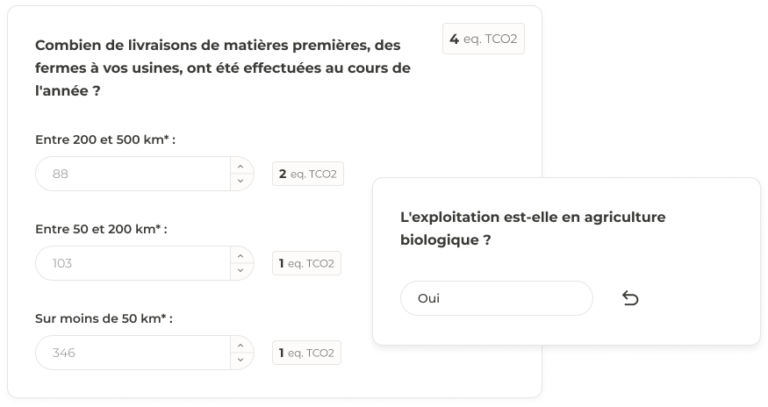
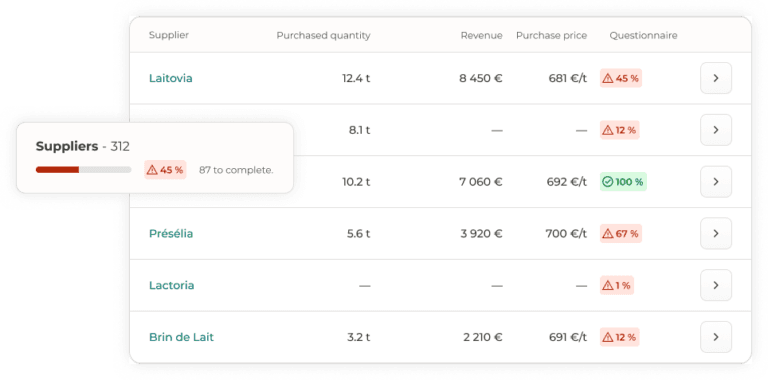
Each questionnaire is designed for a specific trade or product category. Around fifty questions are enough, as 20% of the data covers about 80% of emissions. Your suppliers answer free of charge, without a licence. Your systems do the rest: single sign-on, pre-filling, connection to ERP, PLM, farm management and accounting software. Without a connected system, your invoices are enough to get started.
Science precedes software
Calculation methods audited by Carbone 4 and EVEA, scores verifiable by Bureau Veritas.
Learn more
Our calculations follow the Bilan Carbone® methods, the GHG Protocol, the ISO 14040 and 14044 standards and the official environmental cost framework. Our calculation methods have been audited by Carbone 4 for dairy, by IFIP for the pork sector and by EVEA. Bureau Veritas verifies your scores so that they are enforceable against third parties. The list of emission factors and assumptions remains open to anyone who wants to check the calculation.
At the level of a group as well as a sector
Consolidate the data from your subsidiaries, sites, and members onto a single platform. Each party retains the confidentiality of its figures.
Learn more
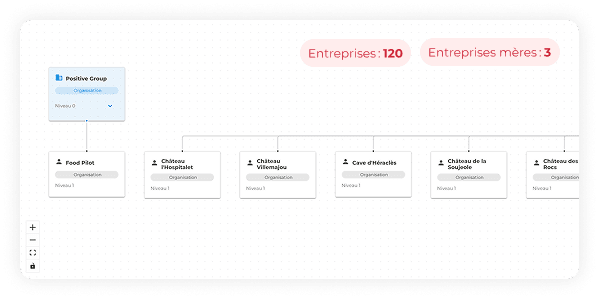
The platform consolidates your subsidiaries, sites, and entities onto a single database, eliminating double counting. It evaluates portfolios of thousands of SKUs by product range and packaging format. Through a collaborative approach, each member sees their individual figures, the network headquarters receives the aggregated data, and statistical confidentiality protects everyone. You conduct the initial assessment with our team, then gradually gain autonomy.
From measurement to management
Simulate the effect of your decisions before making them, then steer your progress trajectories year after year.
Learn more
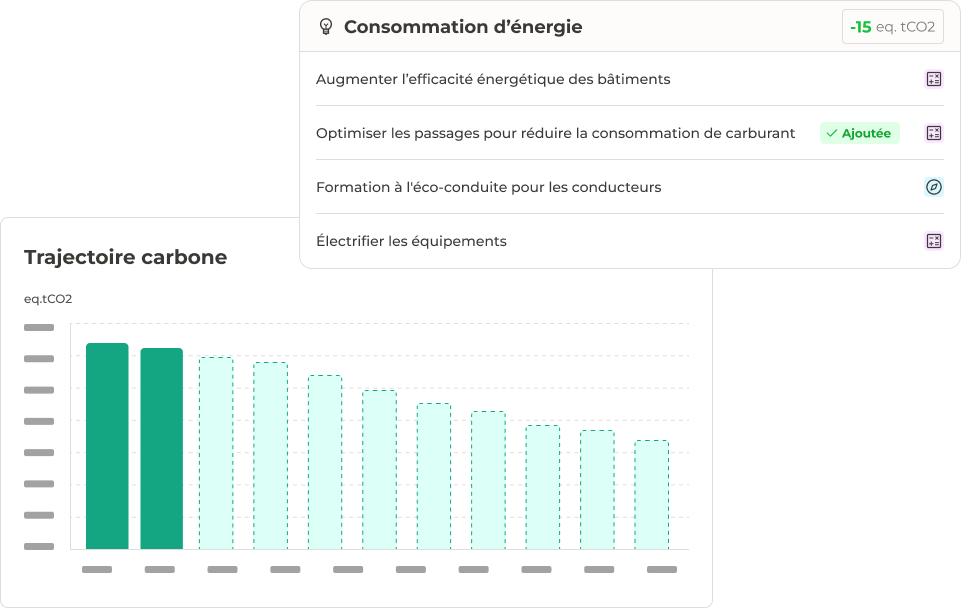
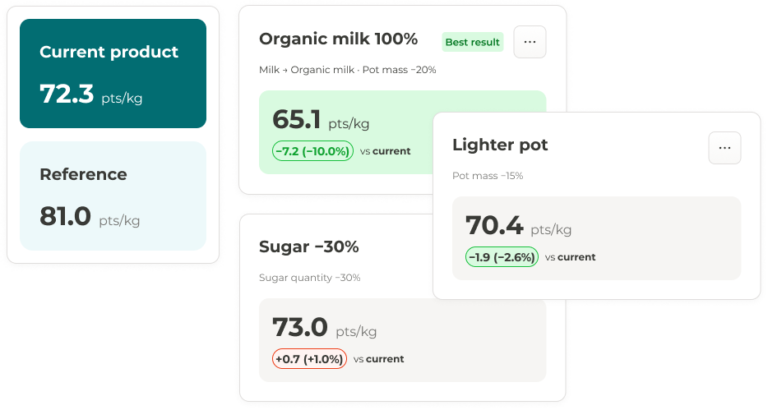
Test a recipe before changing it. Substitute an ingredient, a product's origin, or packaging, and the engine calculates the impact of each scenario. Your teams make decisions based on these figures. The resulting assessment then becomes a roadmap that you manage, with actions categorized by effect and cost. You track these actions year after year, until the deadline you set. Finally, by identifying your lowest-emission products, you can offer them to clients willing to pay more.
Your data stays yours
Your data belongs to you and is hosted in France. You can retrieve it whenever you decide.
Learn more
The contract includes reversibility. If you leave the platform, you leave with all your data. The reference frameworks are updated every year, and your history is kept.
Frequently asked
questions
How does the platform differ from a consulting firm?
A consulting firm delivers a study frozen on its delivery date. The platform calculates continuously: every new piece of data updates your scores and trajectories. The tool and your history stay with you.
My suppliers don't have any data, what can I do?
Their access is free. The questionnaire uses the language of their profession, and industry values fill in the missing answers.
Does the platform cover my reporting obligations, including CSRD?
Yes. The platform covers regulatory reporting, including the CSRD, and product environmental labelling. Each use has its own questionnaires, and your data stays on the same platform, where it also feeds your progress trajectory.
Who verifies the results?
Carbone 4, IFIP and EVEA have audited our calculation methods, and Bureau Veritas verifies the scores. The calculation assumptions remain open to your auditors and clients.